
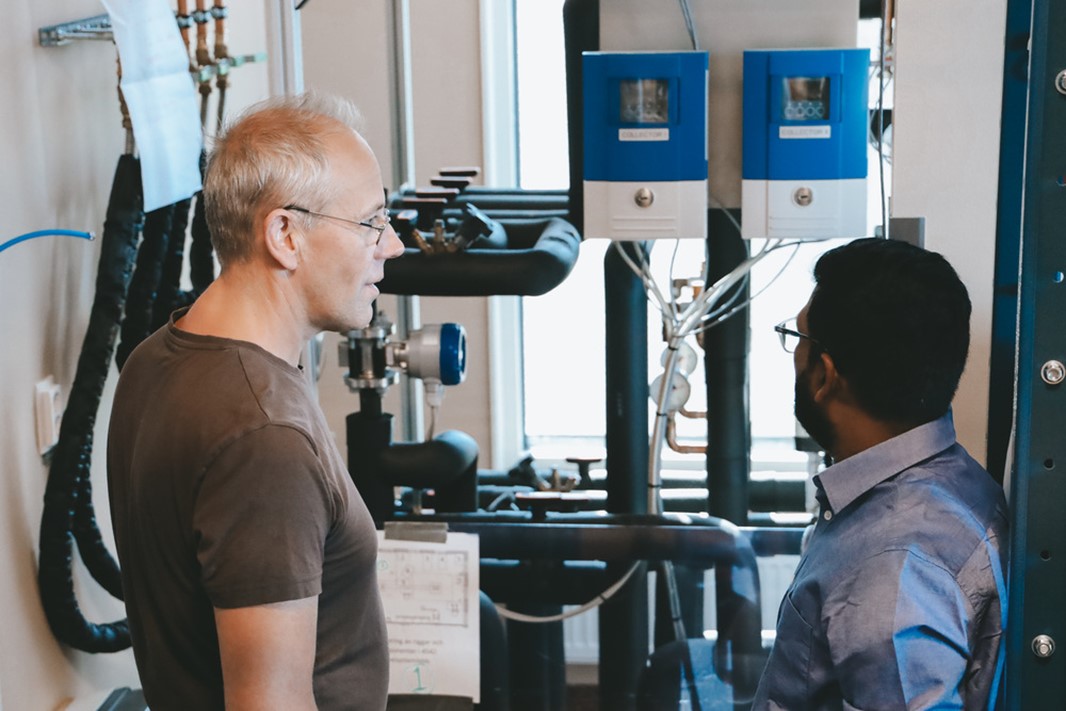
Researchers at Dalarna University will work together with companies, public-sector organisations and other research partners to investigate how district heating infrastructure can last longer, how buildings and neighbourhoods can use energy more efficiently, and how the energy transition can be implemented so that more people benefit from it.
Dalarna University has a coordinating and leading role in three new research projects and will receive approximately EUR 690,000 in funding. The projects are funded by the Swedish Energy Agency under different programmes and address different aspects of the energy transition.
– The energy transition should be resilient, flexible, and inclusive with the added values to the whole society. We also need reliable infrastructure and smarter ways of using electricity and heat. These projects address different parts of the energy system, with the shared ambition of contributing to solutions that make sustainable energy work better in everyday life, says Xingxing Zhang, Professor of Energy Engineering.
The projects are linked to research at the Sustainable Energy Research Centre (SERC) at Dalarna University. SERC brings together expertise from several disciplines to study the energy transition from different perspectives, from energy technologies and energy systems to how solutions work in society. The new projects build on this combined expertise by examining district heating infrastructure, smarter energy use and how the transition can work across entire neighbourhoods.
Keeping the heat flowing safely
A small defect in a joint between district heating pipes can have much wider consequences. If water enters the insulation, heat losses increase, while corrosion can shorten the lifespan of the pipes and ultimately cause disruptions to the heat supply.
In the SEAL-JOINT research project, researchers will investigate how joints can be made more durable and watertight using automatic sealing and healing materials. The aim is to extend the life of district heating infrastructure and reduce the need for costly repairs and the risk of disruption.
Helping buildings share energy flexibility
Solar panels, batteries, heat pumps and electric vehicles create new opportunities in the energy system. But greater benefits can be achieved when buildings and energy resources work together.
In the RE-FLEX research project, researchers will develop tools to tackle the key energy flexibility issue, by coordinating electricity and heating across buildings and neighbourhoods. This could, for example, involve shifting energy use to times when renewable electricity is plentiful, or coordinating batteries and electric vehicle charging to ease pressure on the electricity grid.
The role of district heating in future neighbourhoods
How can district heating and cooling support neighbourhoods that aim to produce more renewable energy than they use over the course of a year?
This is the focus of the SPA-PED research project. Researchers will examine energy flows, emissions and costs, as well as residents’ ability to afford adequate heating and cooling. One aim is to help municipalities and energy companies compare different solutions and understand how the quantitative benefits are distributed.
Facts: Three new research projects
Funding: The three projects have a combined budget of approximately EUR 5 million, of which approximately EUR 690 000 is allocated to Dalarna University.
Coordinator: Xingxing Zhang, Professor of Energy Engineering
Participateing researchers from Dalarna University: Shikha Singh, Jingchun Shen and Puneet Saini
SEAL-JOINT
Dalarna University coordinates the project together with RISE, Öresundskraft, E.ON Energiinfrastruktur, Jönköping Energi and Powerpipe Systems, as part of the Termo programme. The project has a total budget of EUR 440 000, and Dalarna University will receive approximately EUR 220,000 in funding. The project will run from October 2026 to September 2028.
RE-FLEX
Dalarna University coordinates the Swedish consortium, working together with RISE and Electoken, with ElectriCITY, as part of the Clean Energy Transition Programme. The project has a total budget of EUR 2 700 000, and Dalarna University will receive approximately EUR 220,000 in funding. The project will run from December 2026 to November 2029.
SPA-PED
Dalarna University coordinates the project, which is part of the Driving Urban Transition Programme. The Swedish partners include RISE, the City of Stockholm and AFRY, with Stockholm Exergi. The project has a total budget of EUR 1 800 000, and Dalarna University will receive approximately EUR 250,000 in funding. The project will run from January 2027 to December 2029.
Read more about: Sustainable Energy Research Centre (SERC) - Dalarna University
