
Conference theme: Closeness and Wholeness – Business Administration Competence Today and in the Future
In an era characterised by globalisation, digitalisation and growing societal challenges, the question of what it means to be a business administrator and manager – today and in the future – is becoming increasingly relevant. Whilst the demands for specialisation and niche disciplines are increasing, there is a growing need to understand business administration where complementary core knowledge and skills form a coherent whole.
FEKIS 2026 invites a collegial discussion and reflection on how we shape the subject of business administration and the skills needs of the future. At the heart of this are the concepts of Closeness (proximity) and Wholeness (holism).
Closeness is not just about geography, but also about trust, accessibility, local roots and mutual relationships – with students, colleagues and the surrounding community. Wholeness involves developing a comprehensive understanding in line with society’s needs and demands, which is often challenged by boundaries and gatekeepers, tensions and contradictions.
The conference welcomes contributions and discussions aimed at counteracting fragmentation, developing skills from a holistic perspective, and strengthening the subject’s positioning and societal relevance. Examples of themes include:
- Local relevance in teaching – how local businesses and the local economy can be integrated into education
- Closeness in the learning process – how engagement with and between students can be promoted – even in digital or hybrid environments
- Closeness between subject areas – how different sub-fields of business administration can together contribute to a holistic understanding, both in teaching and research
- Closeness and a holistic approach in research – how collegiality and trust can be developed in collaborative projects
- Closeness as a strategy for collaboration – how partnerships with local businesses and organisations can strengthen both teaching and research
This conference is supported by a grant from the Jan Wallanders and Tom Hedelius Foundation and the Tore Browaldh Foundation, as well as by funding from Lars Erik Lundbergs Stiftelse för Forsknings och utbildning (Lars Erik Lundberg Foundation for Research and Education).
Start | Handelsbanken Research foundations
Lars Erik Lundberg Foundation for Research and Education
Conference Program
- 09:30: Welcome & Fika (Peter Hultén, Dalarna University)
- 9:45 – 11:00: Workshop on intercultural communication (Sarah Ramsay, Dalarna University)
- 11:10 – 12:00: Thrown to the lions: Survival tips for balancing a PhD with teaching (Peter Hultén, Dalarna University)
- Lunch
- 13:00 – 14:00: Early career: Building a future in research: On postdocs and research funding (Christina Öberg, Linnaeus University)
-
14:00 – 15:00: Crossing borders in academia: A personal story of interdisciplinary collaboration and finding one’s research group (Anna-Carin Nordvall, Uppsala University)
-
15:00: Fika
-
15:30 – 16:30: avigating the early career stage: On the job market for fresh PhDs (Josef Pallas, Uppsala University)
-
16:30 – 16:45: Summing up and key takeaways (Peter Hultén, Dalarna University)
-
19:30: Evening networking session (details will be published later)
Morning (9.30–12.00)
- Welcome speech
- How Will AI Redefine Work? Exploring Uncertain Futures (panel discussion)
- Proximity and wholeness: The importance of higher education institutions for regional development (panel discussion in Swedish)
Afternoon (13.00–16.45, ev. until 17.50 for city tour participants)
- Parallel sessions
- In the Footsteps of Erik Johan Ljungberg (optional city walking tour, in Swedish)
Evening (18.30–22.00)
- Pre-dinner drinks and Conference dinner at Quality Hotel Galaxen: Quality Hotel Galaxen Borlänge
Morning (9.15–11.45)
- Are Sweden’s business and economics scholars good for Sweden’s economy? (plenum session in Swedish)
- FEKIS Annual General Meeting
Afternoon (12.45–15.30)
- Parallel sessions
- Closing of the conference
See the Swedish conference webpage for the full program
Plenary Sessions
How Will AI Redefine Work? Exploring Uncertain Futures
This panel explores how artificial intelligence may redefine work, with a particular focus on business administration and management and its implications for education, research, and organisational practice. Bringing together perspectives from AI research, HR and organisational transformation research, labour market analysis, and managerial practice, the session addresses how AI may reshape managerial work, knowledge-intensive professions, and competence requirements.
The discussion will begin with short opening reflections from each panellist on the question: How may AI redefine work in the future? These reflections will serve as a basis for a broader, interactive discussion.
A key point of departure is the uncertainty surrounding AIs long-term impact on employment and job content. The panel will also consider how AI intersects with demographic challenges and changing labour market conditions, and what this means for organisations, employees, and educational institutions.
Drawing on analytical, technological, and practice-based perspectives, the panel explores alternative scenarios rather than predictions and reflects on the future of business administration competence. In line with the conference theme Closeness and Wholeness Business Administration Competence Today and in the Future, the discussion will consider how technological, human, and organisational perspectives can be integrated in preparing for an evolving and uncertain future.
Panel discussion moderated by Lenka Klimplová, Senior Lecturer in Business Administration, Dalarna University
Panel participants:
- Eva Lindell (mdu.se), Associate Professor in Business Administration, Mälardalen University
- Arend Hintze, Professor in Microdata Analysis/AI, Dalarna University
- Ari Iso-Rautio (linkedin.com), Chief Transformation Officer, ex-vice-president of Egremont Group
- Jan Sundqvist (linkedin.com), Labour Market Analyst, Svamac
Closeness and Wholeness: The Importance of Universities and University Colleges for Regional Development
Our country has a significant number of universities and university colleges. They vary in age, size, and orientation. All of them play important roles in the development of our country, not least at the regional level. The latter is particularly important to highlight at a time when the positions of different higher education institutions in global competition are increasingly emphasised. The panel will address the role and future of higher education institutions.
Panel discussion moderated by Lars Engwall (uu.se), Professor of Business Administration, Uppsala University (Session in Swedish)
Panel participants:
- Jörgen Elbe, Vice-Chancellor of Dalarna University, Professor Business Administration
- Helena Höij, Governor of Dalarna County
- Liza Lundberg, Chair of the Falun Municipal Executive Board (S)
- Björn Rinstad, CEO, Leksands Sparbank
Are Sweden’s business and economics scholars good for Sweden’s economy?
Bo Rothstein (gu.se), Professor of Political Science, University of Gothenburg (Presentation in Swedish)
Session moderator: Maria Norbäck (gu.se), Professor of Business Administration, University of Gothenburg
The Swedish economy is currently characterised by two serious problems. One is low productivity, and the other is a large proportion of long-term sickness absence with psychosocial diagnoses. The Swedish Social Insurance Agency’s analysis of the sharp increase in these sickness absences shows that more than eighty per cent report having become ill due to their work. Employee-owned firms are uncommon in Sweden but are relatively widespread in other countries such as the United States, the United Kingdom, Italy and Spain. According to extensive research, these firms are characterised by significantly higher productivity and a higher degree of job satisfaction than capital-owned firms. Given these research findings, a question arises as to why interest in employee-owned firms is virtually non-existent among economists in Sweden. This marked lack of interest applies both to the education of scholars in business administration and economics and to research. It also applies to scholars who are prominent in public debate, as well as to the many economics-oriented organisations and think tanks that claim to safeguard a well-functioning market economy. For these reasons, it is reasonable to ask whether Sweden’s business and economics scholars are good for the Swedish economy.
More on the topic: "Varför är personalägda företag överlägsna i termer av produktivitet, innovation och arbetsvillkor?" (pdf, arenaide.se).
Travel and Accommodation
The easiest way to travel to Borlänge is by train. The journey takes around 3 hours from Stockholm Central Station and approximately 2.5 hours from Arlanda Central Station.
Many hotels are located close to both Borlänge railway station and the campus:
- Elite Hotel Brage, Borlänge (elite.se)
- Quality Hotel Galaxen (galaxen.com) (The conference dinner on Wednesday 14 October will take place there)
- Scandic Borlänge (scandichotels.com)
- Best Western Gustaf Wasa Hotel (bestwestern.se)
- Hotell Kupolen (hotellkupolen.se)
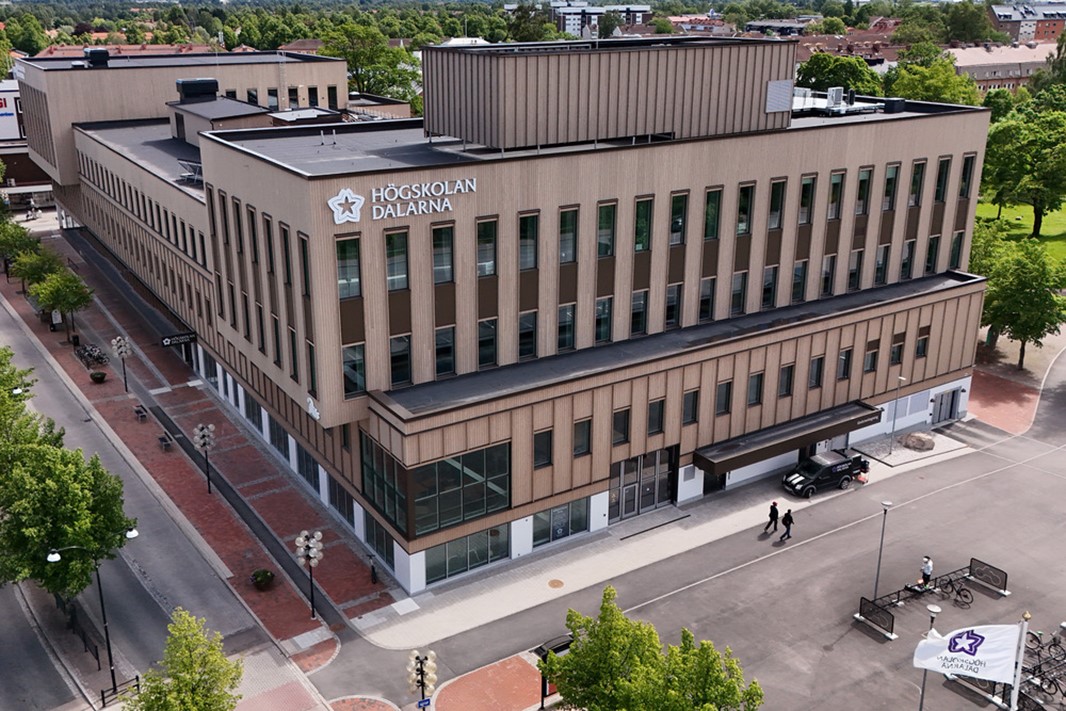
Directions to Campus Borlänge (Google Maps)
Parking at Campus Borlänge
Outside the campus, there are paid parking spaces close to the campus building. Free parking can be found, for example, along Jussi Björlings väg near Folkets Park.
Parking in Central Borlänge (Borlänge kommun)
Navigate the campus with MazeMap
With the digital navigation tool MazeMap, you can easily navigate our campus.

