
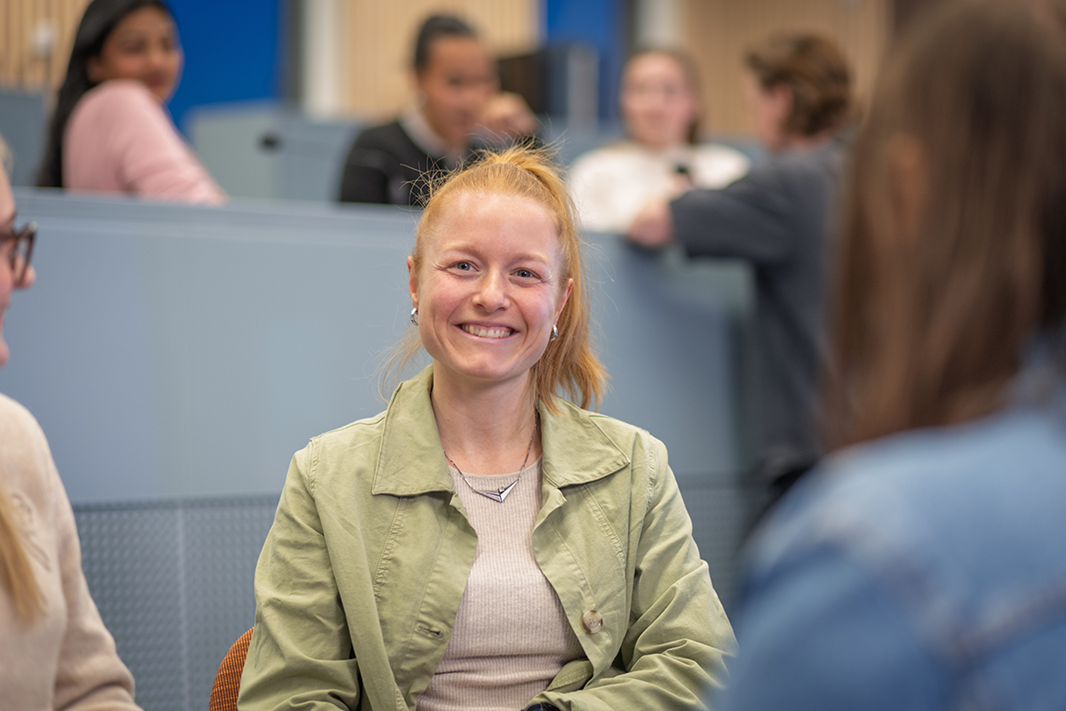
That's how Franziska from Germany describes her experience at Dalarna University. After studying and working in tourism across Europe, Franziska chose to continue her academic journey in Sweden. During her time at Dalarna University, she has developed specialist knowledge in destination development and gained valuable experience of working with real-world challenges.
Why did you choose the programme?
– I came to Sweden with a Bachelor's degree in Tourism and was looking for opportunities in the tourism industry. After speaking with Tobias Heldt at the Centre for Tourism and Leisure Research (CETLER), I realised that a master's degree in Tourism Destination Development could add value, create networking opportunities and improve my chances of becoming involved in tourism projects. How could I say no?
How would you describe the programme?
– The programme is almost like a full-time job, but with flexible working hours. This meant that discipline and a genuine interest in the tourism industry were a strong foundation for me. The study workload should not be underestimated, and being disciplined helped me a lot to stay on track with the pace of the programme.
At the same time, it is a great opportunity to make the most of it for your own personal and professional development. What I mean by that is that the programme includes a lot of research work, which can actually be very rewarding if you choose topics that genuinely interest you and deepen your knowledge from assignment to assignment. In this way, you can become a specialist in your own area of interest within destination development.
What have been the most valuable parts of your education?
– What I valued most were the field trips at the beginning of the programme, where especially international students had the opportunity to learn a lot about Dalarna’s landscape and industries. In addition, our programme coordinator always tried to create extra value, for example by organising the Blended Intensive Programme (BIP), where we joined a field trip together with international students from France and Italy to the SITE destination. I really appreciated this experience, as it almost felt like a small family trip.
Another highlight was the guest speakers from the industry, such as the Travel Trade Manager from Visit Dalarna and representatives from Falun 2027, who visited us and openly shared insights into their work. This helped me better understand what working life in tourism organisations actually looks like and made the transition into the professional world feel less intimidating.
What does it mean to you that your education has strong connections to industry and society?
– Tourism being strongly connected to industry and society has made me realise how complex, but also how interesting and dynamic the field is — especially because it’s so multidisciplinary.
I can clearly see the link between what I study, what stakeholders need, and how society can benefit from new knowledge and solutions. Not studying my field in isolation, but in constant connection with how it is actually used and needed in industry and society, really adds value to my education and makes it feel more impactful.
How relevant do you think your studies are to real-world challenges?
– The programme constantly encouraged us to look at complex situations, think critically and find practical solutions to tourism-related challenges.
Because tourism is such a multidisciplinary field, I learned to approach problems from different perspectives. One of the most valuable lessons was realising that there is rarely one right answer. Instead, it is about researching, reflecting and finding the best possible solution based on the information available.
Through my studies, I also became more confident in dealing with uncertainty and approaching challenges in a structured way.
What is your thesis about?
– My thesis explores how visitors and residents perceive autonomous buses in a winter tourism destination. I am particularly interested in what shapes people's willingness to use this type of technology before they have actually experienced it.
More specifically, I focus on trust, perceived benefits and how these factors influence people's intention to use autonomous transport. My research helps explain what needs to be in place for people to feel comfortable accepting autonomous transport in rural tourism destinations.
What have you learned from combining studies and research?
– Being part of a project that combines research, education and societal development helped me understand how closely these areas are connected.
What stood out most was seeing that research is not abstract – it can influence real decisions that affect people's everyday lives. The project made my work feel meaningful, and I realised that I am most motivated when I can contribute to something with real-world relevance and impact.
How has the programme prepared you for your future career?
– My education has given me a strong foundation for critical thinking, reflection and problem-solving. It has also shown me the value of collaboration and partnerships, and how different perspectives can help address complex challenges.
Overall, the programme has helped me develop a bigger-picture way of thinking, which makes me feel well prepared for a career in tourism and related fields
Advice to future students
– My main advice is to put your own interests at the centre of your assignments. That makes the work not only more enjoyable, but also more meaningful and rewarding.
I would also encourage students to see every assignment as an opportunity for personal development. Good time management is important, and it helps to step back from your work from time to time to avoid getting stuck in details.
Most importantly, stay positive and try to see value in every experience, even when things feel challenging!
About Franziska
Before starting her master's studies at Dalarna University, Franziska studied Entrepreneurship, Leisure and Tourism Business in Austria, worked in the hospitality industry and completed an Erasmus exchange semester in Borlänge. Originally from Germany, she moved to Falun in 2023. During her studies, she connected her thesis work to the SIKTA research project, which explores autonomous transport in tourism destinations.
Programme: Master's Programme in Tourism Destination Development
Exchange studies: Erasmus semester at Dalarna University
Professional background: Hospitality and tourism industry
Thesis linked to: SIKTA – autonomous transport in tourism destinations