
The concept "active lethal violence" refers to incidents in which one or more perpetrators subject the general public to life-threatening violence, typically until they are stopped by someone else (Swedish Civil Defence and Resilience Agency).
Such incidents may include school attacks, acts of terrorism or other forms of violence in public spaces.
The probability of an attack with deadly violence occurring at Dalarna University is assessed as very low, yet the consequences of such an attack, if one was to occur, are serious. Therefore, it is up to each of us to know what to do if faced with such a situation.
In the event of an incident involving ongoing deadly violence, you need to act quickly. The guiding principle has three fundamental steps: flee, seek shelter and sound the alarm.
In the event of active lethal violence
Flee
- Find a safe place.
- Leave the area as quickly and safely as possible, and avoid crowds.
Seek shelter
If you cannot leave the area, find a place that you consider safe and that will give you protection.
- Lock or block doors if possible.
- Turn out the lights.
- Look and listen, and try to remain calm.
- Put your phone on silent and turn off the vibration mode.
- Do not call anyone who may be in the risk area. This may reveal a person who is hiding.
Sound the alarm
When you are safe, call the police: 112.
Try to provide information about the following:
- Where the incident is taking place.
- What has happened.
- How many perpetrators you have seen.
- What, if any, weapons you have seen.
- How to identify the person(s) and their latest position.
Remember:
- Use your mobile phone only if you must. If the network becomes overloaded, it can be difficult for crucial calls to get through.
- Follow the instructions of the police, fire department and other authorities.
- Remember, you may be a resource for the police - for example, you can give them your university keycard.
- Do not share unconfirmed information online or in any other way.
- Make sure the police can see your hands: when they arrive, it may be difficult for them to determine who is the perpetrator and who is the victim; they need to see that you are unarmed.
- Notify your immediate manager when the situation is over and safe.
The Swedish Civil Defence and Resilience Agency has put together a training film about what to do in the event of a violent incident, such as a terrorist attack.
The online training also provides information about how to help people who are injured and how to stop bleeding. It will take you between 15 and 30 minutes to complete.
This is how you ought to act in the event of a terrorist attack
Lockdown buttons
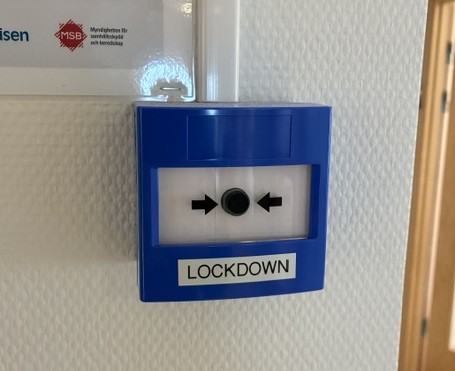
Lockdown buttons are installed at Campus Borlänge and Campus Falun. These are to lock doors quickly.
They are blue and look like fire alarms. When these are activated, all doors that have card readers lock. To use them then requires your university keycard + code.
Be sure to locate the nearest lockdown button in your area of the building.
The buttons can be found at these campus locations:
Campus Borlänge
- one in the reception, 1st floor
- one in the caretaker's office, 1st floor
- one in the staff lounge, 3rd floor
Beside each button, there is a notice with information.
Campus Falun
Lugnet:
- one at the reception, 1st floor Hyttan (main building)
- one in the caretaker's office (vaktmästeriet), 1st floor Hyttan (main building)
- one in the corridor, 3rd floor, Smedjan
Mediehuset:
- one near the offices, 1st floor
- one near the technicians, 2nd floor (rum 2-095)
Beside each button, there is a notice with information.
Preventive measures
You can help to prevent incidents by doing the following:
- Make note of people behaving oddly and report this to Securitas: connection 8088 or 010-470 10 00 - they will send a security guard.
- Find out the layout of your workplace, for example, where can you evacuate? Where are the emergency exits?
- Do not allow unauthorised people onto premises where access is restricted.
- Report risks and incidents to your immediate manager. This enables the organisation at different levels to take preventive measures and act when there is a risk.
