
This news item was published more than six months ago and may no longer be relevant.
During the period, which spanned the fall semester, Charlie taught the programming course "Exploring Data in R and Python" for mathematics and statistics students, while continuing his research on algorithmic pricing and data analysis.
The purpose of the sabbatical has been to strengthen international experience and contribute to the development of teaching at Swedish higher education institutions.
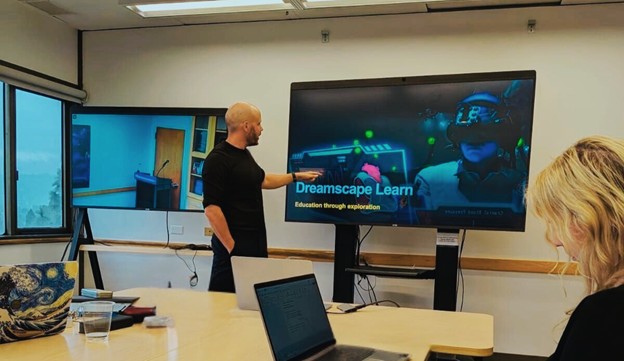
A central feature during the visit was participation in a seminar for STINT fellows held at the University of California Los Angeles (UCLA). At this meeting, Charlie gave a presentation focusing on how teaching is conducted at ASU, including the use of advanced equipment such as Dreamscape Learn with VR headsets, as well as traditional classroom teaching and online instruction. The presentation visually centred on the concepts of "Dreamscape Learn" and "Education through exploration," reflecting the STINT program’s goal of gaining an understanding of learning and teaching processes and contributing to pedagogical renewal.
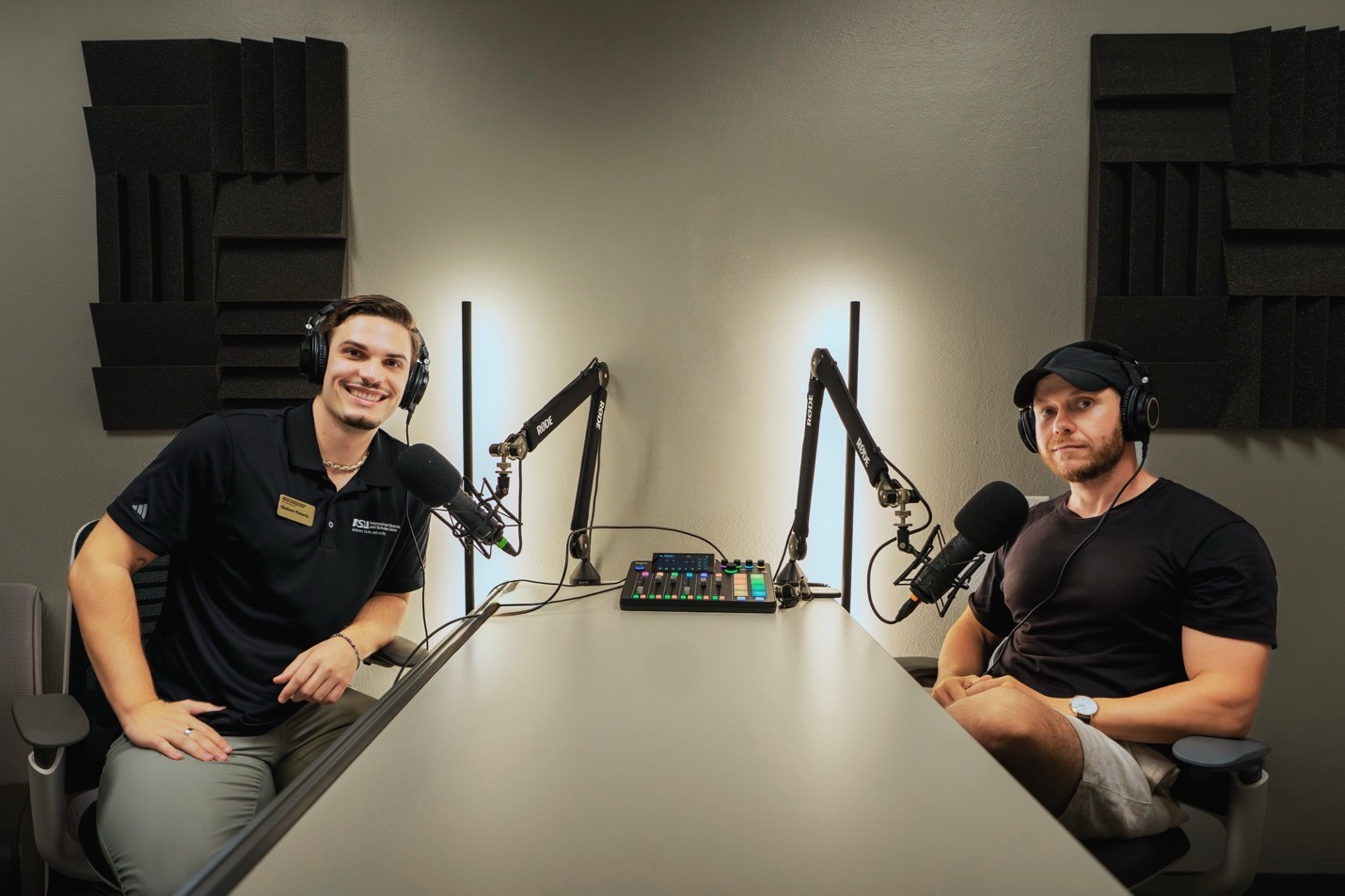
Furthermore, Charlie participated in a podcast event together with the International Students and Scholars Center (ISSC). The podcast focused on Charlie's experience of living and teaching in Arizona (information outside the sources). The ISSC at ASU functions as the program sponsor for J-1 Exchange Visitors (EVs) and is the entity responsible for keeping the U.S. Department of State informed of the scholar's activities during the exchange. Cooperation with the ISSC includes mandatory Student and Exchange Visitor Information System (SEVIS) check-in and orientation required to validate a scholar's status.
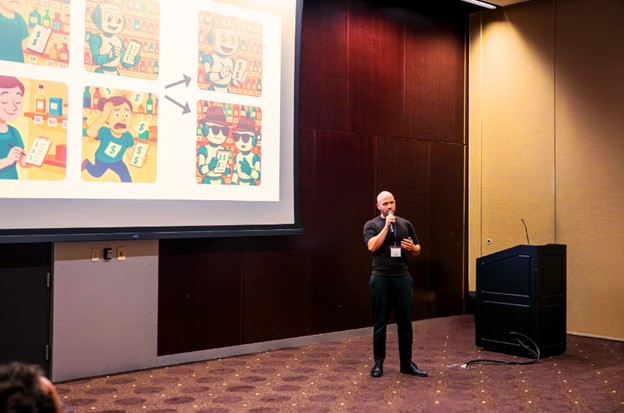
Another important professional appearance was Charlie's research presentation in a format similar to the 3 Minute Thesis (3MT) or Researchers' Grand Prix, held before ASU faculty and international scholars. The presentation addressed Charlie's research in algorithmic pricing and data analysis, utilising visual elements that suggested themes around pricing, decision-making, and possible hidden agendas as well as profits. This competition format, which challenges researchers to present their research to a non-specialist audience in approximately three to four minutes, was first developed as 3MT by The University of Queensland (UQ) in Australia in 2008. In Sweden, where the competition is called Forskar Grand Prix (Researchers' Grand Prix) and is coordinated by Vetenskap & Allmänhet (VA), it was first arranged in 2012. Giving such a presentation allows a visiting scholar to demonstrate their engagement in scholarship at a university such as ASU.
Charlie's sabbatical in the US formally concludes in December, marking the end of the J-1 program, after which the Exchange Visitor has a 30-day grace period to remain in the U.S. for purposes such as travel and packing, but may not be employed, engage in research activities, or perform unpaid work. Dalarna University's international ambitions are underscored by the fact that two fellows were accepted the same year, which is unusual and a clear signal of the institution's commitment to pedagogical development. As part of fulfilling the STINT program requirements, Charlie is expected to write a final report and, in late January or early February (Information outside the sources), present his collected experiences at a follow-up seminar in Stockholm. STINT places great emphasis on ensuring the returning lecturer's experiences are used by the leadership to bring about change and renewal at the Swedish higher education institution.
