
This news item was published more than six months ago and may no longer be relevant.
Over 2 days researchers and PhD students, both on our campus and online, took part in a meeting of the Nordic Network for Algebra Learning .
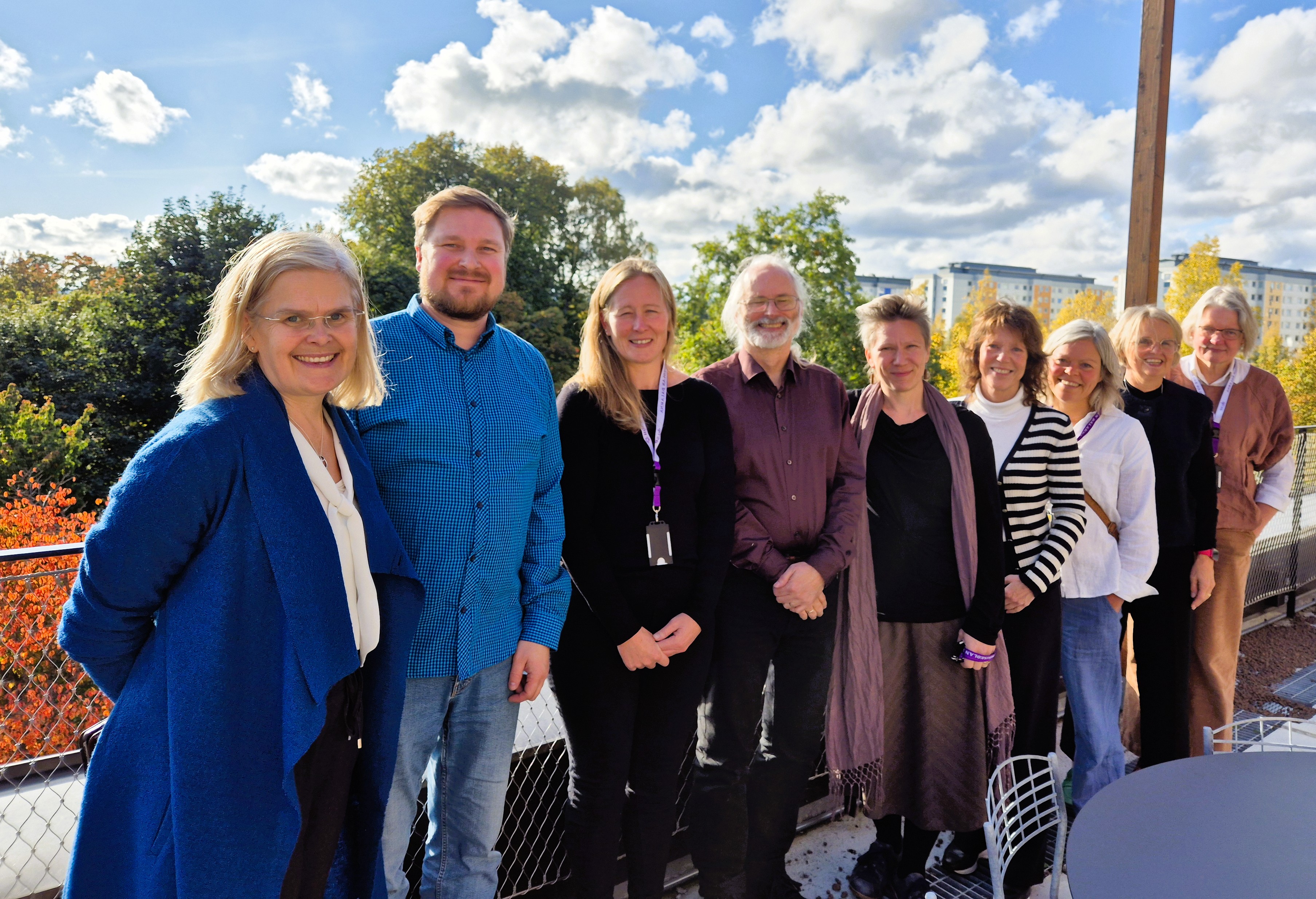
On the first day, Helén Sterner welcomed everyone before Professor Lovisa Sumpter from Stockholm University presented her keynote speech entitled What makes algebraic reasoning algebraic?
This was followed by presentations covering a variety of topics:
- Students’ handling of parameters in modelling – presented by Heidi Strømskag (Norwegian University of Science and Technology)
- Flexibility and adaptivity in arithmetic and algebra - presented by Pernille Bødtker Sunde (VIA University College Denmark)
- Multiple representations of algebraic thinking - presented by David Reid (University of Agder)
- Exploring Preservice Teachers’ Reasoning and Sense-Making of Growing Patterns in Mathematics - presented by Constanta Olteanu (Linnaeus University)
- Flexibility and its connections to course success among university students - presented by Anne-Maria K. Ernvall-Hytönen (University of Helsinki).
During the second day, under Kristina Palm Kaplan’s leadership, the ongoing projects within the Nordic Network for Algebra Learning were discussed with particular attention to their current content and future direction. These discussions were informed by the four thematic areas which currently structure the network’s collaborative work, including:
- Teaching and formative assessment of algebraic competencies - lead by David Alexander Reid
- Cross-Nordic differences and mathematical generalisation - lead by Helena Eriksson (Stockholm University), Birgit Gustafsson (Karlstad University), Kristina Palm Kaplan (University in Gävle)
- Algebra as a tool for mathematical modelling - lead by Heidi Strømskag, and
- Interventions and large-scale assessments - lead by Peter Hästö (University of Helsinki)
Last reviewed: